
Jun 26, 2026
The Legacy of a Senior Scientist
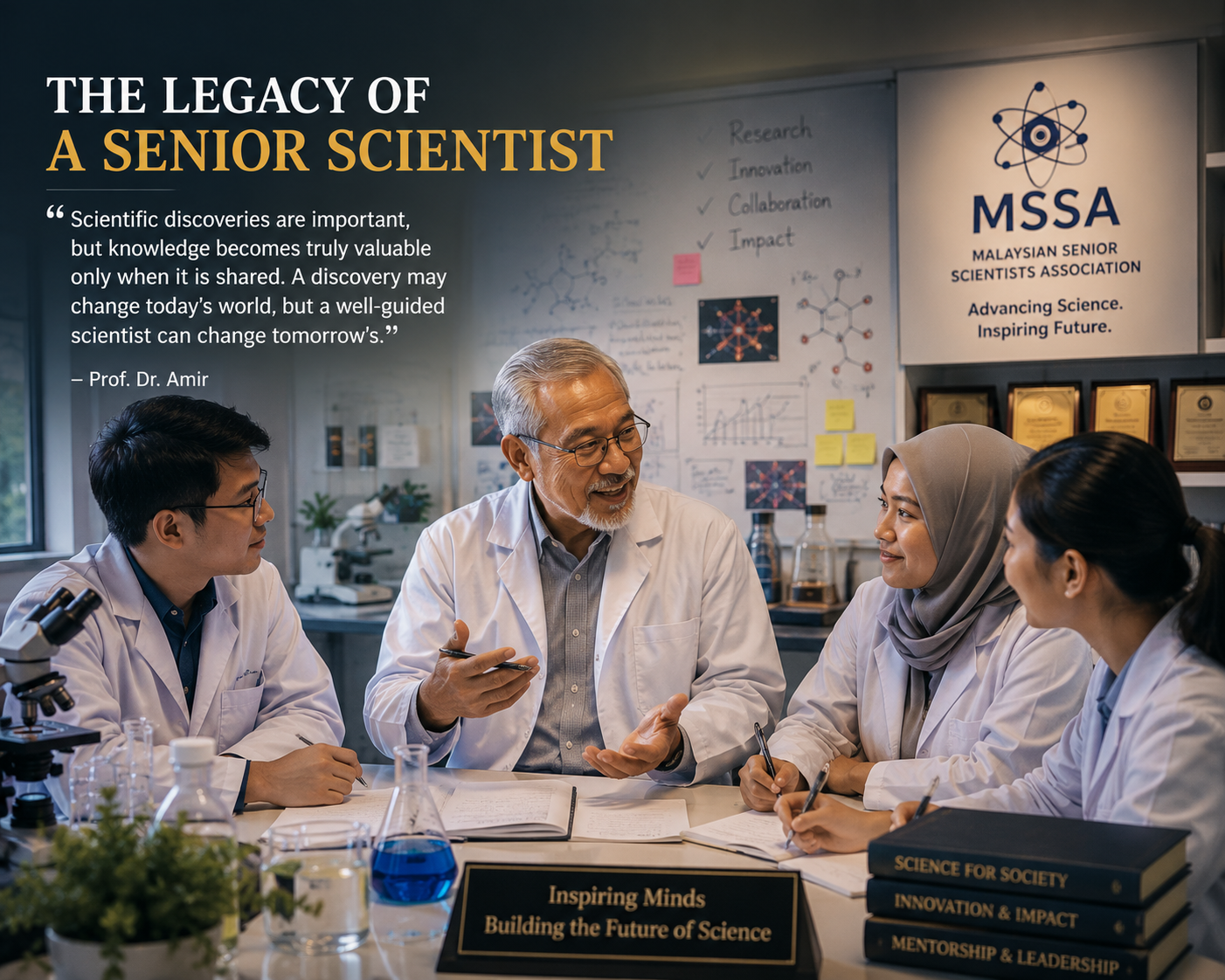
For more than forty years, Professor Dr. Amir devoted his life to science.
His office was modest. The shelves were filled with worn notebooks, research journals, and photographs from conferences held across the world. Awards and medals rested quietly in a corner—not because they were unimportant, but because he believed every discovery belonged to the entire scientific community.
One afternoon, a young researcher visited him.
"Professor," she asked, "after publishing hundreds of papers and receiving so many honours, what do you consider your greatest achievement?"
The professor smiled, looked at an old photograph on his desk, and replied,
"None of these."
He pointed to the picture showing a group of students standing proudly beside him many years earlier.
"Every one of them is now a scientist, professor, engineer, or innovator. They are solving problems I could never have imagined. That is my greatest contribution."
The young researcher looked surprised.
"But your discoveries changed industries."
Professor Amir nodded.
"Scientific discoveries are important, but knowledge becomes truly valuable only when it is shared. A discovery may change today's world, but a well-guided scientist can change tomorrow's."
Throughout his career, he had mentored dozens of postgraduate students, advised government agencies, collaborated with universities, and encouraged researchers from different disciplines to work together.
He often reminded his colleagues,
"Science has no finish line. Every answer leads to a new question, and every generation must prepare the next."
When he retired from full-time academia, Professor Amir did not stop contributing. Instead, he joined the Malaysian Senior Scientists Association (MSSA), where he found a community of distinguished scientists who continued to serve the nation through mentorship, policy advice, public engagement, and scientific collaboration.
At every MSSA forum, he saw familiar faces—scientists who had spent decades advancing medicine, engineering, agriculture, environmental science, physics, chemistry, and technology. Although retired from their formal positions, none had retired from their passion for science.
Together, they guided young researchers, supported national scientific initiatives, and reminded society that experience is one of the nation's greatest scientific assets.
During one of the Association's annual gatherings, Professor Amir concluded his speech with words that received a standing ovation:
"Success in science is not measured by how many discoveries you make. It is measured by how many minds you inspire, how many lives you improve, and how much knowledge you leave behind for the generations that follow."
His legacy was never confined to laboratories or research papers.
It lived on in every scientist he had inspired.
The true legacy of a senior scientist is not simply the knowledge they create—it is the wisdom they pass on to those who will shape the future.